Details
Important
Before you decide to travel with GEEO, it is important that you read all of the program information on this page. Our programs are quite adventurous, and we find that travelers who review the full trip details are happier with their experiences.
Trip Notes & Expectations
ACCOMMODATION
Our program fees are based on double-occupancy accommodation (see "Single Travelers" below if you do not have a travel companion and would be interested in a private room). Our accommodations are chosen to provide a safe, conveniently located place to sleep. While you may be pleasantly surprised, please don't expect luxury, as we prioritize keeping our programs affordable. Accommodation in western Tibet (particularly at Everest Base Camp) is extremely basic - only multishare rooms may be available, little or no running water, and basic pit toilets.
A variety of styles of hotels/guest houses are used on this trip. In many instances, they might not be like what you are used to back home, as service and efficiency can vary. In some areas, we stay in simple local guest houses in stunning locations - rooms are small and simple, and there may only be shared toilet facilities and showers. A sleep sheet/bag is recommended, as whilst there is plenty of bedding and (in most cases) it does get washed, it can be dusty and cold, especially in winter/Spring.
INTERNET CENSORSHIP
Many websites and apps are blocked in mainland China, including Google, Gmail, Facebook/Messenger, Instagram, WhatsApp, YouTube, many news websites, and certain Wikipedia pages. It is possible to bypass the "Great Firewall of China" using a VPN. If you do not use a VPN, it is important to let your family and friends know that you might not be able to stay in touch using your usual methods (e.g., social media or email). We recommend installing a VPN (e.g., LetsVPN) on your device prior to travel. Search "China travel VPN guide" for more information and advice.
LUGGAGE
This trip uses (sometimes crowded) local transport, so please note that a backpack is much more suitable than a suitcase for this style of travel. On trains, luggage will need to be stowed either in overhead racks or in the limited luggage spaces between carriages, so travel as light as possible. Please be aware that properties we stay in with only two stories may not have elevators installed, and climbing the stairs with your luggage will be necessary.
ACTIVITY LEVEL & PACE
This trip includes plenty of walking and some light hiking, and requires at least an average level of fitness. The key challenge on this journey is not the pace, but the high altitude. The itinerary is designed with a slower pace to allow for acclimatization, especially in the first few days in Lhasa. You'll be exploring on foot, which will involve walking on uneven surfaces and navigating stairs, particularly at iconic sites like the Potala Palace. The climate can be cool and dry, so come prepared with layers. We recommend having snacks handy as meals can sometimes be far apart.
ALTITUDE
This trip operates at altitudes over 3500m (max altitude 5630m). Whilst we travel slowly, allowing plenty of time to acclimatise, you may experience headaches, nausea, and lethargy on arrival in Lhasa. It is important to be aware of the effects of altitude, especially on long driving days.
WEATHER
The sun is intense - hat and sun screen are essential as well as drinking plenty of water as altitude exacerbates dehydration.
TRANSPORTATION
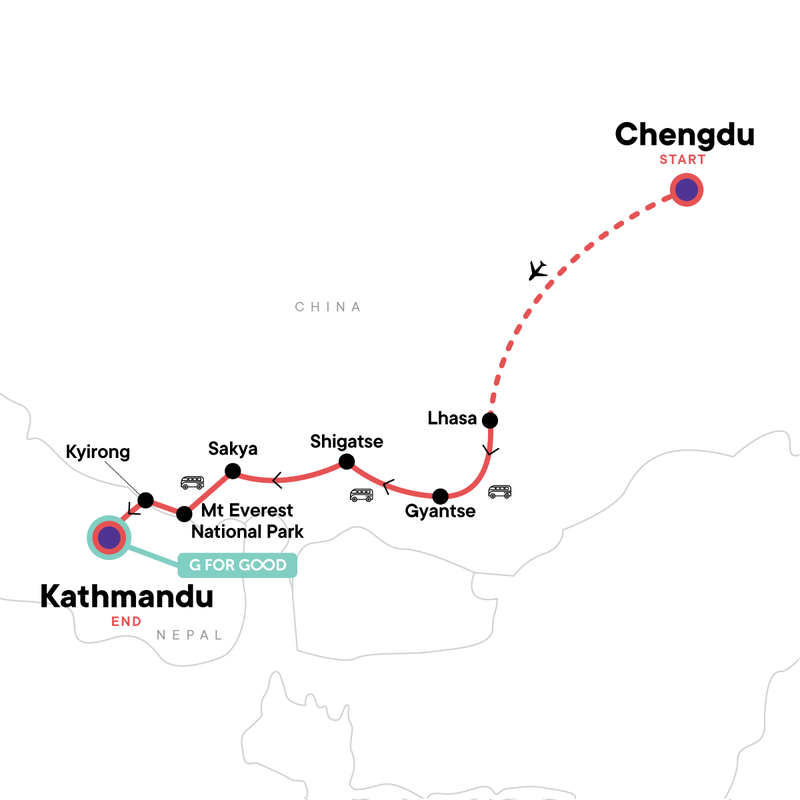
We use a private minibus for portions of this tour through Tibet and into Nepal. While the border crossing between Tibet and Nepal is quite new, it's important to note that roads in general in remote areas of these countries are often narrow, winding, and poorly maintained, so be prepared for bumpy rides. That said, the stunning views more than make up for a bit of discomfort.
INTERNAL FLIGHTS
All local flights are included in the cost of your tour unless otherwise noted. It is important that we have your passport information at the time of booking in order to process these tickets. Internal flight tickets are issued locally and will be given to you prior to the flight departure.
PROGRAM DETAILS
Single Travelers
Traveling solo? You’re in good company—about half of our participants do the same.
Shared room by default. The program fee covers one person in a twin room. We’ll pair you with a roommate of the same gender if you don’t have a travel companion.
Want a private room? Most trips offer a
“My Own Room” (single-supplement) upgrade. Check the price in the
Extra Services section, then email travel@geeo.org to reserve it. You pay the single-supplement only if you request it.
My Own Room Exception: Receive private accommodation every night except night 8 at the guesthouse.
Emergency Contacts
If you need urgent help during your trip,
call the local G Adventures office first. If no one answers, leave a detailed message with your name and contact information so they can return your call as soon as possible.
EMERGENCY CONTACT NUMBERS:
G Adventures Local Tour Operator (China)
Head Office: +86 18122213686
Beijing Office: +86 010-65128789 or +86 13379009576
If you are unable for any reason to contact the local office, please call the numbers listed below, which will connect you directly with the 24-hour Sales team, who will happily assist you.
Toll-free, North America only: 1 888 800 4100
Calls from UK: 0344 272 0000
Calls from Germany: 0800 365 1000
Calls from Australia: 1300 796 618
Calls from New Zealand: 0800 333 307
Outside North America, Australia, New Zealand, Germany and the UK: +1 416 260 0999
Packing List
See our blog post of
staff recommended gear to help you pack for your upcoming travels. You must be able to carry your own luggage—up stairs, on and off of transport, and during 15 to 20 minute walks. Bring
one small or medium backpack or rolling bag (22-30lb) and
one daypack for daily items. Space is limited on transportation, so oversized bags cannot travel.
*
Do not bring any knives to China.* If they do make it into the country, they will not be permitted on trains.
As you prepare your packing list, we recommend checking average weather conditions for your destination on a site like
Weather Spark for the time of year you will be traveling.
SuggestedOptionalDocuments
- Modest clothing that covers knees and shoulders and shawl/scarf for temples
- Rainjacket and/or umbrella
- Winter coat, hat and gloves
- Modest personal clothing for hot (humid upper 80's F) to cold weather (evening in the mountains where it gets down into the 40's F) – we recommend packing 7-8 days of outfits so you only have to do laundry once.
- Comfortable (preferably waterproof) walking shoes suitable for moderate hiking
- Daypack
- Sunblock
- Sunglasses
- Sun hat
- Lightweight silk sleep sheet (Important!)
- Money belt
- Watch or alarm clock (or use your phone)
- Camera (or use your phone)
- Toiletries
- Face masks (used commonly in China during travel, especially during times of illness or poor air quality)
- First-aid kit, including: lip salve, aspirin, bandaids, anti-histamine, Dramamine, Imodium or similar tablets for mild cases of diarrhea, electrolyte powder, insect repellent, extra prescription drugs you may be taking
- Travel pillow
- Water bottle
- Phone/tablet for internet – most hotels have WiFi
- Chargers for electronics as well as converters/adapters, if needed
- AirTags or Tile trackers
- Packing cubes
- Flip-flops/sandals
- Earplugs
- Snacks – packing a few granola bars is a good idea; you can buy snacks locally, so don’t go crazy here
- Ziplock bags for wet clothing
- Reading/writing material
- Hand sanitizer/baby wipes
- Passport (with photocopies)
- Travel insurance (with photocopies)
- Airline tickets (with photocopies)
- USD/EUR cash
- Credit or debit card (see personal spending money)
- G Adventures vouchers, pre-departure information, and dossier
- Any entry visas or vaccination certificates required
- GEEO Classroom action plans for your group – this is sent 10-30 days before departure
*Laundry: Laundry facilities are offered by some of our hotels for a charge. You can also use a local laundromat, if necessary.
Passports and Visas
Travelers are responsible for securing all required travel documents and meeting the entry requirements for every country on their itinerary, including applicable transit/layover countries.
PASSPORT
All travelers must have a passport valid for
at least 6 months beyond your trip dates with enough blank pages for stamps.
Need to apply or renew? Start here.
ENTRY/VISA REQUIREMENTS
Visa rules change frequently—always verify the latest requirements on the
U.S. State Department Country Information Pages. Non-U.S. passport holders should verify requirements with your country's official government resources. Use the tool below to see entry requirements for your specific itinerary.
Entry information below is provided by Sherpa, a third-party service and trusted G Adventures partner. You must search each of your destination countries separately; “Add connection” solely searches transit visa requirements. Additional fees apply if you choose to purchase any services through Sherpa.
Money Exchange
The local currency in
China is the
yuan (¥ CNY), also officially known as the
renminbi (RMB), which translates to "People's Currency." For current exchange rates, visit:
www.xe.com.
Cash is rarely used. Nearly all payments are made through mobile apps like
WeChat Pay or
Alipay. We strongly suggest downloading one or both apps before traveling China and setting up your account, linking your credit/debit card(s), and enabling data roaming or using an eSIM to access the apps while in china.
We recommend
Airalo for eSIMs. Get
10% off using code
GEEO10.
Important Notes
— Be sure to review the terms and conditions when setting up WeChat Pay and/or Alipay.
— Credit cards may work with in large cities like Beijing and Shanghai, but you may have problems in other cities or towns, so it is best to
have multiple payment methods ready.
The local currency in
Nepal is the
Nepalese rupee (NPR), although the Indian rupee is also widely accepted. For current exchange rates, visit
www.xe.com.
Credit cards (especially Visa and Mastercard) are accepted at many hotels, shops, and restaurants, but not everywhere. Some vendors may also charge an international transaction fee, so check with your bank before you travel.
For small purchases, tipping, or places that don’t take cards, we recommend using ATMs to withdraw local currency while traveling. If you bring U.S. dollars to exchange, the bills must be new, unmarked, and in excellent condition—damaged or older notes are often rejected.
Emergency Funds: Bring
at least $200 USD (or the equivalent in local currency) in cash for emergencies in case of ATM or card issues. Always carry more rather than less to avoid feeling short of funds while traveling.
See the Estimated Trip Costs section at the bottom of this page for budgeting guidance.
For more advice, see our post,
Smart Travel Finances: Your Guide to Money, ATMs, Fees, and Safety Abroad
Tipping
Tipping is not traditionally practiced in China, so there is no need to tip in restaurants, but tipping is customary in the tourism industry.
Tipping is optional but appreciated and goes a long way for the people who look after you on the trip. If you are happy with the service, use these ballpark amounts and adjust as you see fit:
- Local guides and drivers:
$1-3 USD per person per day.
- G Adventures tour leader (CEO):
$5 USD per person per day.
(We suggest pooling contributions in an envelope and presenting it as a group)
Tipping Kitty: On some trips, your CEO may suggest a
“tipping kitty” where everyone contributes at the start of the tour, and the CEO uses that pooled amount to tip service providers for the group as a whole (not including your CEO). If your CEO doesn’t mention it and you’d like to use a kitty, we recommend asking about it early in the trip. Your CEO will advise the suggested amount and preferred currency for the kitty.
Vaccinations
GEEO cannot provide any medical advice, so it is very important to consult your doctor or a travel clinic about which vaccinations you will need for your trip. We recommend contacting
Passport Health, which has travel clinics located throughout the United States. You can also check the
CDC's recommended vaccinations for your destination. Please take this seriously!
Flights
Wait for official trip confirmation via email from GEEO before booking your flights. Prices tend to be lowest 90–120 days out, but that window varies by route and year. Neither GEEO nor G Adventures bear responsibility for any flights purchased before the trip is confirmed.
This program
begins in Chengdu and
ends in Kathmandu. Please double-check our itinerary for the date by which you must arrive in Chengdu. You may want to arrive in China one or more days early in case you have flight disruptions. You can arrive at any time you choose, but try to make it in time for our 6:00 p.m. Welcome Meeting on Day 1. You can depart from Kathmandu any time on the final day of the program, or stay later to see more of the city.
Plugs and Converters
Most power sockets in China accept
Type A, Type C, and Type I plugs and Nepal uses
Type C and Type D plugs. In both countries, the voltage is
230V. To use your electronics safely, you’ll need to consider:
1.
Adapter (plug shape)
Adapts your U.S. plug to fit another type of socket. See our recommended
all-in-one travel adapter in our Gear Recommendations post.
2.
Converter / transformer (voltage)
Steps the outlet voltage down to 120V for U.S. appliances that can’t handle higher voltage.
How to know which you need: Look at the fine print on the plug or power brick. An
“Input 100-240 V” means the device is dual-voltage and works worldwide with only an adapter—phones, laptops, and most camera chargers fall into this category. If the label shows
“Input 120 V” (hair dryers, curling irons, some shavers), it could be damaged on high voltage. Pack both an adapter and a travel voltage converter. Converters are inexpensive and sold online or in the travel aisle of many stores.
Weather
You will go through a range of temperatures on this trip. Chengdu will be humid with highs in 80's. Tibet will be very comfortable, with highs in the 60 and 70's and lows in the 40's. Kathmandu will once again bring humid weather in the 80's. Be prepared for some rain and thunderstorms, especially in the afternoon.