This program is open to educators and their families, and the minimum age is 8 years old.
If you are looking for a trip to Morocco with GEEO that is only open to adults, check out our two-week Morocco programs in summer 2026.
Hotels: Standard Class
03/15/2026 - 03/22/2026
Max Participants: 14
8 Days / 7 Nights
Overview
Bring your whole family along on a journey through Morocco, a country rich in history, culture, and natural beauty. This fast-paced adventure is short enough to fit in your Spring Break week. The program blends the country's most iconic landmarks and cultural highlights with a little free time to explore on your own. Follow in the footsteps of ancient Berber traders as you wander the labyrinthine alleys of Fès and Marrakech, explore the high-walled kasbahs, and traverse the majestic dunes of the Sahara on a camel ride. Immerse yourself in the region's rich history, cuisine, and customs as you engage with local communities, all while earning professional development credit with other educators.
This is a fast-paced itinerary that covers lots of ground. While it allows us to see a great amount in the available time, it also means some early starts, some long drives in the minivan, and less free time than many other GEEO programs.
Ramadan starts on the evening of Tuesday, February 17, and ends at sundown on Thursday, March 19. Ramadan is a month of fasting observed by Muslims throughout the world, during which time the followers of Islam should not eat or drink between sunrise and sunset. There may be some limitations to services and disruptions to schedules during Ramadan, but generally our tours still operate effectively during this period and food is available to non-Muslims throughout the day.
What's Included:
Volubilis Roman ruins guided tour
Fes Medina guided tour
Mhaya Village Community Lunch
Sahara Desert excursion with camel ride
Todra Gorge stay with walk through local villages
Aït Ben Haddou Kasbah visit
Marrakech medina guided walk
G Adventures tour leader throughout and local guides
Hotels (7 nts)
7 breakfasts, 1 lunch, 1 dinners (allow USD $390-510 for meals not included)
All transport between destinations and to/from included activities by private air-con van, camel
Arrive at any time. There are no planned activities until the Welcome Meeting in the evening. The nearest airport is Casablanca Mohammed V International Airport (CMN).
Explore Casablanca: This tour does not spend any time in Casablanca. Consider arriving 1-2 days early to explore the city, adjust to the time zone, and buffer against flight delays. We can request extra hotel nights for you before the program begins.
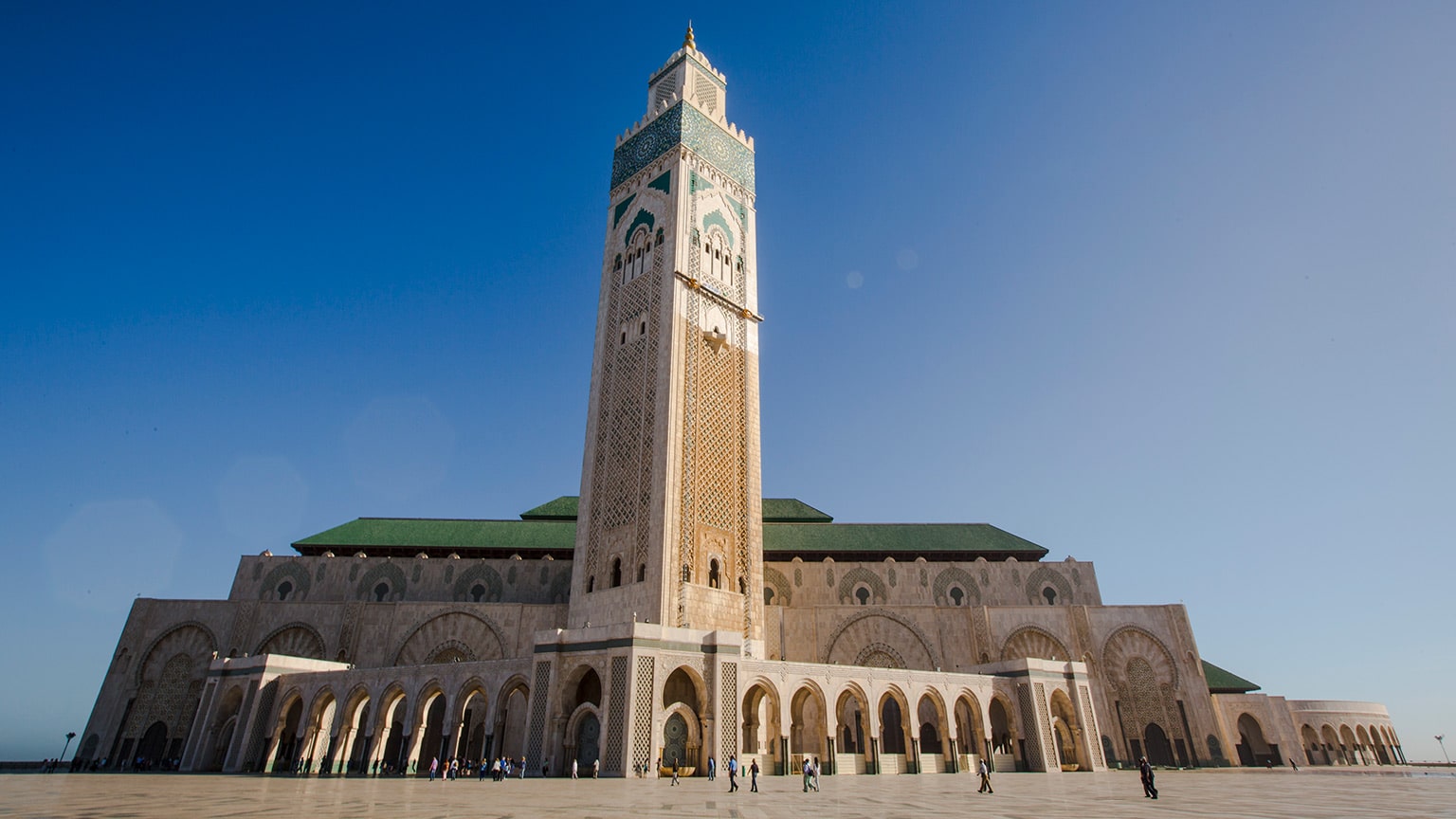
We recommend visiting Casablanca’s small medina, beachfront, and notable Art Deco architecture. A must-see is the Hassan II Mosque, open for guided tours from Saturday to Thursday at 09:00, 10:00, 11:00, and 15:00. You can pre-book guided tours on Viator.
Hotel Check-in and Welcome Meeting
Hotel check-in is normally between 2–3 p.m. Check with reception for the exact time and location of the group welcome meeting, typically between 6–7 p.m. Please make every effort to attend this meeting. If you're running late, send a message in the group WhatsApp or call the emergency number on your trip voucher so that your tour leader can let you know where and when to meet the group.
After the meeting, you might choose to get dinner at a nearby restaurant with your traveling companions and your tour leader to further get to know one another.
Joining Instructions
Taxi: (~300 MAD / ~$33 USD | ~1hr) Available at the airport entrance. Taxis are metered—ensure the meter is reset before departure. The drive to the hotel is approximately 20 miles. Note: Most taxis only accept cash. Exchange a small amount at the airport (enough for taxi fare plus a 10-15% tip).
Pre-Booked Arrival Transfer: If you purchased a transfer with us, look for the driver holding a G Adventures sign outside Terminal 1. Ask them who they are collecting (do not give your name—they should already have this information). Once they confirm the correct name, show your passport and you're on your way. A tip of 10-15% is customary for your driver.
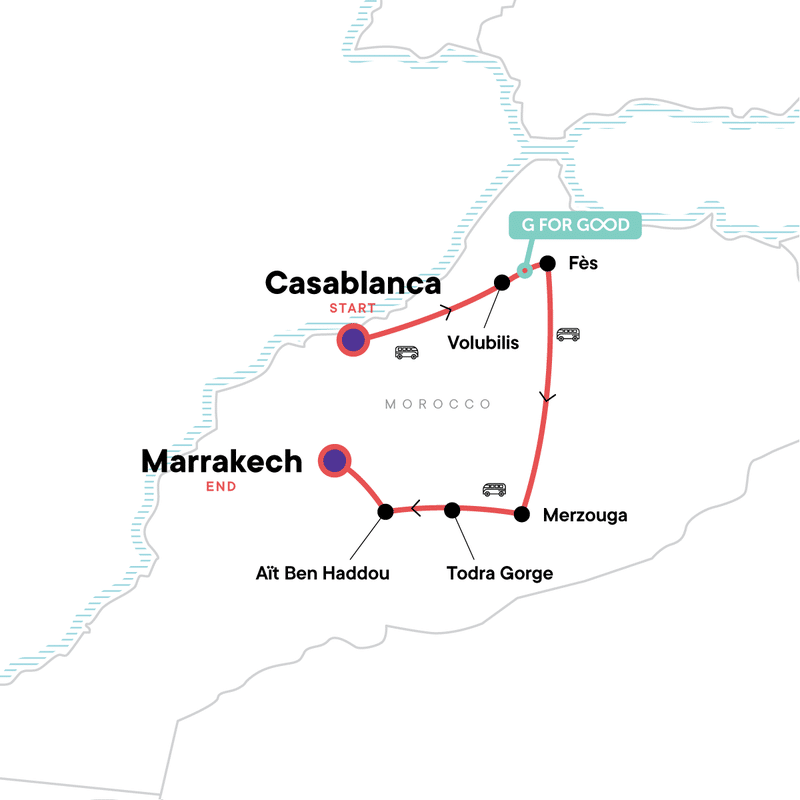
This morning, leave Casabaanca and drive to the AFER Association, where we enjoy a traditional lunch that benefits rural Moroccan women and children with disabilities. The association provides vital services including literacy and vocational training, health services, disability assistance, and the operation of a local ambulance. AFER’s training center hosts culinary programs that graduate 30 students each year, many of whom go on to work in the project. Through this work, AFER creates sustainable employment, fosters community cohesion, and showcases Moroccan culture to travelers. During your visit, you will enjoy a traditional home-cooked Moroccan meal, featuring classic dishes such as vegetable tagine or roasted chicken with onion sauce, and meet some of the women that are part of this important community program.
Next, listen to a certified local guide explain life in the Roman Empire at the UNESCO World Heritage Site at Volubilis. Visit the impressive, well-preserved Roman ruins, peer into old bathhouses, marvel at the still-present mosaic floors, and gaze up at towering marble pillars. Hear stories about life in this Roman city that will leave you in awe of just how far their empire stretched.
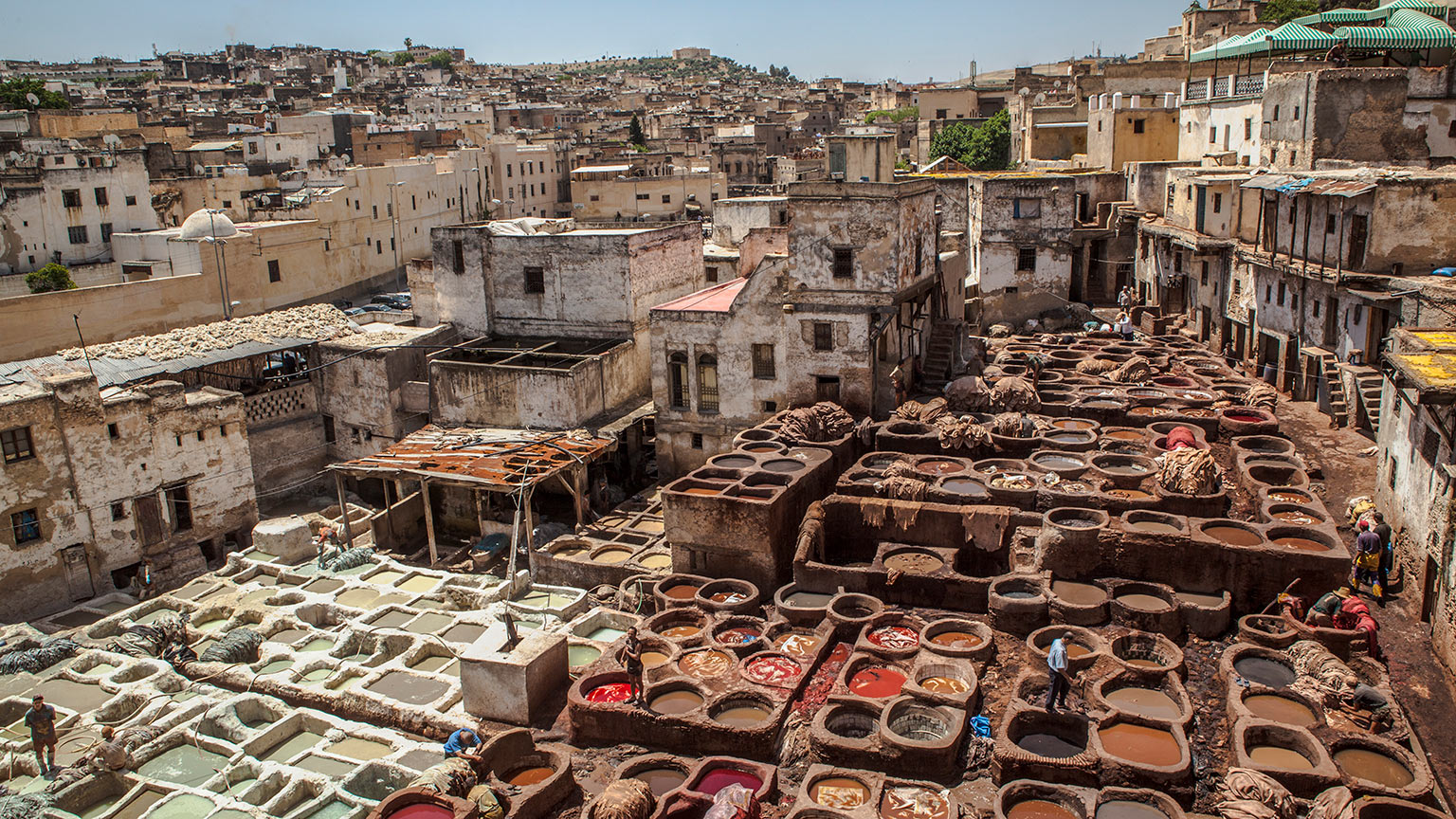
After, continue to Fès, one of Morocco's most interesting cities. Take some free time to explore the labyrinth of streets, and view one of the ancient tanneries from above to see the myriad of colors and observe the leather tanning processes.
Approximate travel time: 6 hours including stops in private vehicle Meals included: Breakfast | Lunch
The Fez medina is the world’s largest living medieval medina and a UNESCO World Heritage Site. Enter through one of the great gates into the chaos and follow a local guide through this 1.4-sq. mile medina with more than 9,000 winding streets. Some buildings in the medina date back to the 9th century; there are 350 mosques in the medina that are still in use today. We will explore the artisan quarters, sample treats from the carts, and visit the mausoleum and the Al Qarawiyin UniversityA highlight is the view of the famous Fès tannery from the balcony of a leather shop, where you can observe the men hard at work treating and dyeing the different hides. Take some time to shop for leather goods before returning to your hotel.
Please note: Only certified local Fez guides are allowed to guide in the medina. During your free time, your tour leader (a nationally certified guide) cannot accompany you here.
Enjoy free time this afternoon.
This evening there may be the chance to partake in an optional dinner in a grand old Fès riad that has been converted into a spectacular restaurant. Enjoy a delicious meal of local specialties while enjoying an evening of entertainment that includes singing, music, and belly dancing.
Today we have a full travel day through the diverse landscapes that make Morocco so unique. As you pass through cedar and pine forests, keep an eye out for Barbary Macaques. Pass over the Middle Atlas Mountains through the pre-desert countryside with its deep gorges filled with a splendid oasis of green palm groves, finally arriving at the sand dunes of the Sahara Desert. Keep your eyes open for a glimpse of Barbary apes en route.
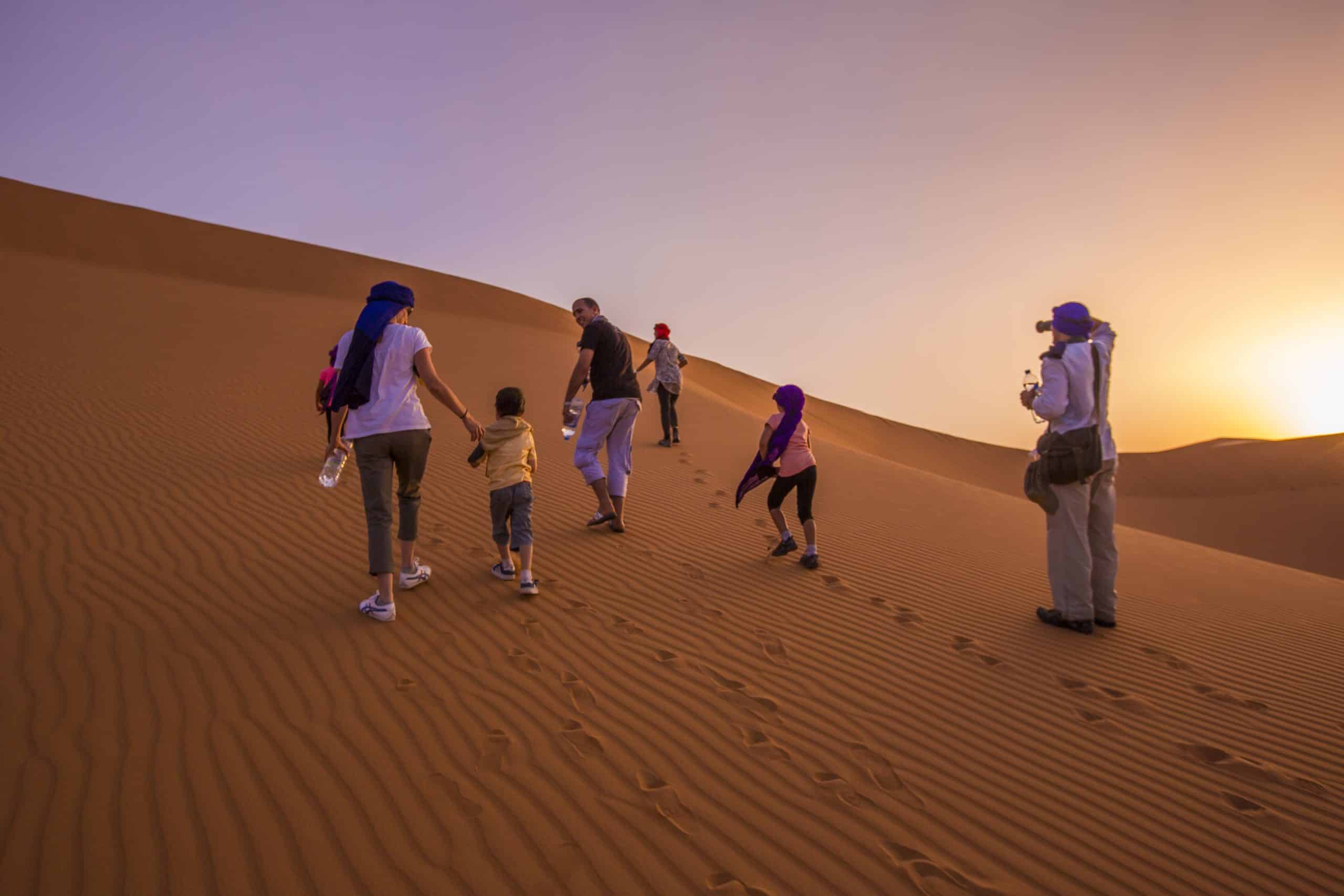
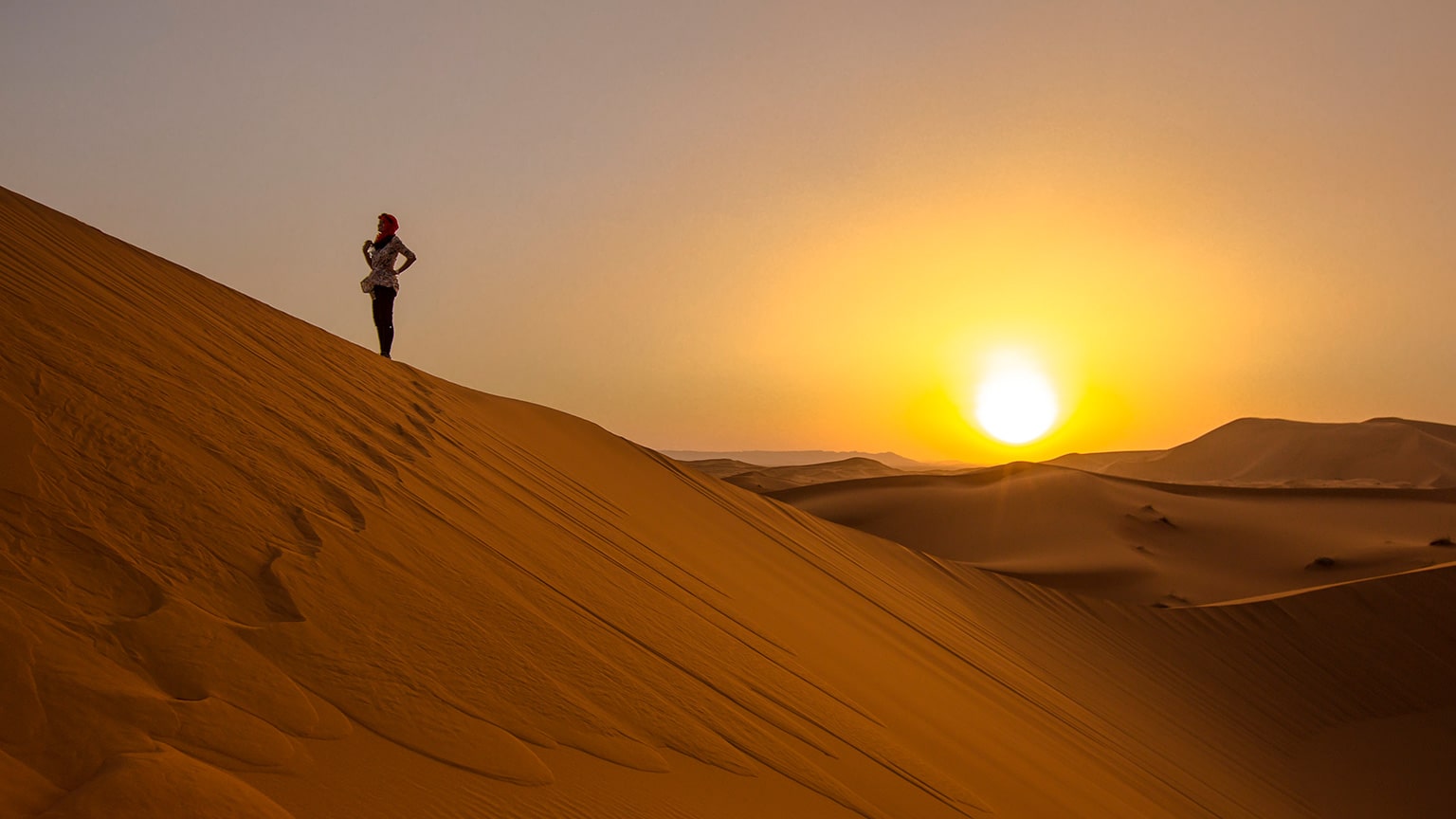
Upon arrival, settle into your hotel at the edge of the dunes and enjoy a warm welcome with mint tea. In the late afternoon, take a camel ride deep into the dunes to watch the sunset. Local guides will teach you how to mount and dismount and other handy camel-related safety tips. Be sure to get them to teach you the trick of tying your turban to keep the desert sun off your face and add a little flair to your photos.
We spend the night in a desert auberge, located right on the edge of the dunes, where we will have a local-style dinner. Please note: some rooms may have shared bathroom facilities. After dinner, gather around a campfire under the stars near your hotel. Listen to stories about life in this region and, perhaps, some traditional music on the drums.
Rise early to watch the sunrise. Opt to spend the morning exploring the undulating golden sand of the dunes and discovering the surrounding communities on a land cruiser desert excursion. After breakfast, continue by private bus into the Todra Valley.
The Todra River has carved out cliff-sided canyons through the mountains with the final 300 m of the gorge being the most spectacular, as the canyon narrows to a flat stony track as little as 10 m (33 ft) wide in places with sheer and smooth rock walls up to 160 m (525 ft) high on each side. Today, the Todra River looks more like a stream as it runs its way through the gorge, with hotels and restaurants huddled against the steep walls. It is easy to walk through the gorge, as there is a well-maintained dirt road to walk along. This scenic and serene spot is great for hiking, relaxing on the edge of the river, or sampling some local Amazigh (Berber) delicacies.
Approximate travel time: 3.5 hrs, including stops Meals included: Breakfast
This morning, we continue along the "Route of 1,000 Kasbahs" to the thriving town of Ouarzazate for a lunch stop. This town is home to Atlas Film Studios, where many films have been shot over the years, including Lawrence of Arabia and Gladiator.
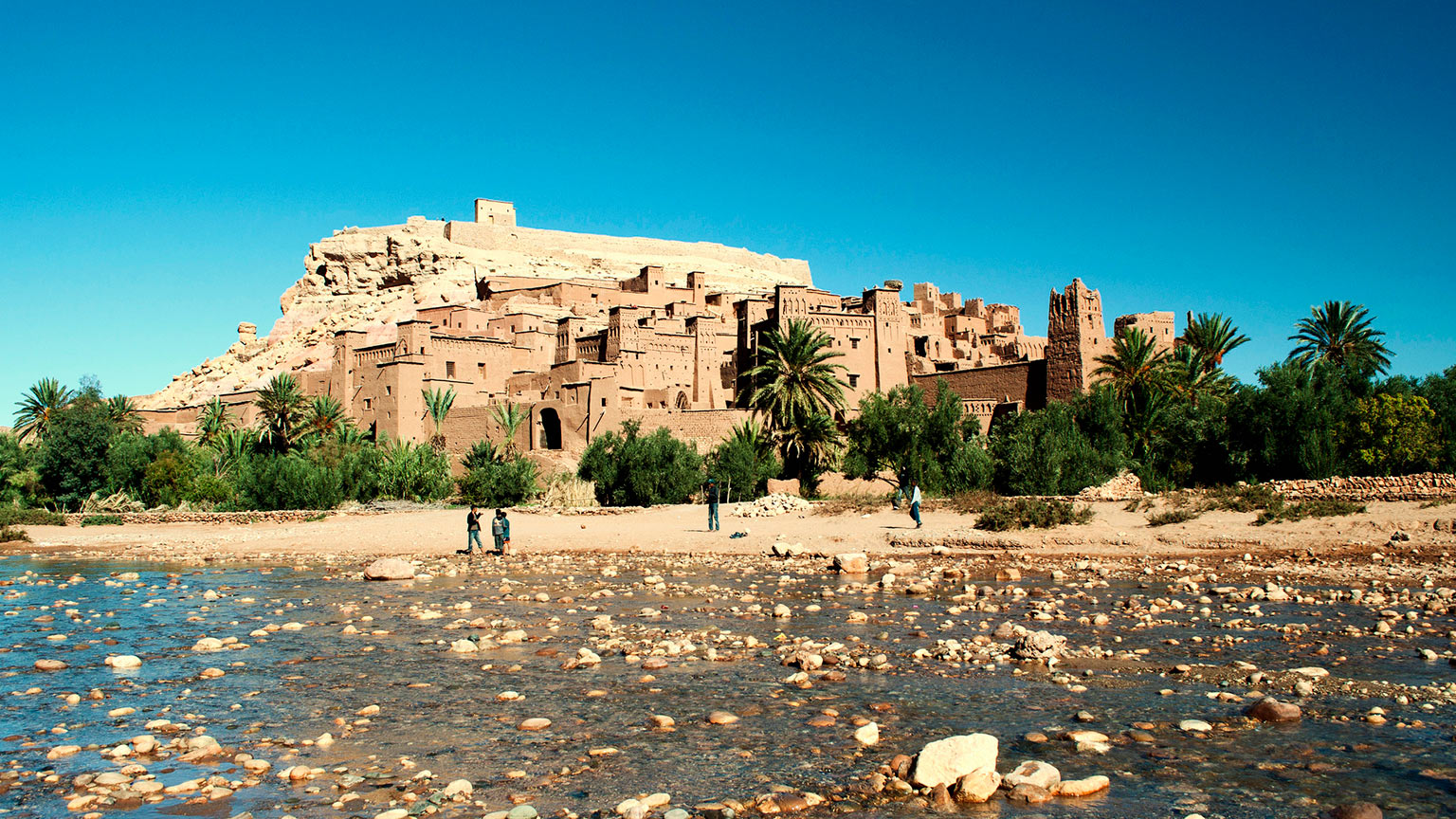
Continue on to the fascinating and beautiful village of Aït Ben Haddou, a wonderful example of a kasbah (a type of fortress). Explore the UNESCO World Heritage Site with your tour leader. Of all the remaining kasbahs in Morocco, the walls and interior of this area are the most intact. Like many of the earthen-built fortresses in Ouarzazate, Aït Ben Haddou has been used in many film and television productions like Gladiator, Babel, and Game of Thrones.
In the evening, there may be a chance for an optional cooking class. Learn the secrets of how to make the perfect tagine and then sample your skills for your dinner.
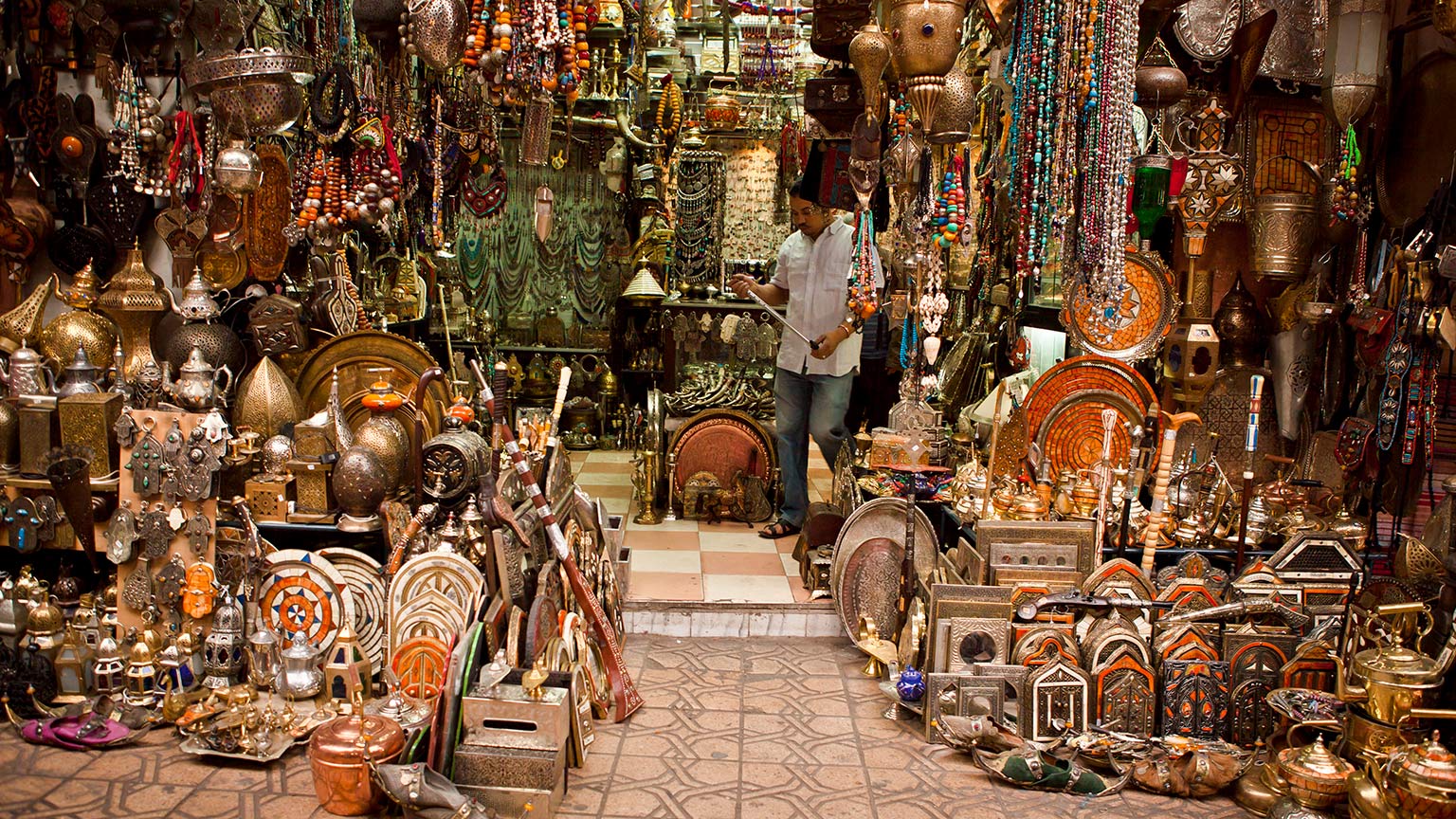
In the morning, we continue our journey to Marrakech with breathtaking views through the High Atlas Mountains via the Tizi n’Tichka Pass (7400 ft). Once you arrive in the "Red City," join your certified city guide for a tour of the Marrakech medina. Shop to your heart’s content in the souks with their narrow, winding streets as you search out spices, traditional jalabas and slippers, or the famous Moroccan lanterns. Visit the historical Koutoubia Minaret and gardens, the Mellah, and the Saadian Tombs, a complex of sepulchers and mausoleums that house the remains of Saadian Sultan Ahmed Al Mansour Ed Dahb. The tombs were sealed off until their re-discovery in 1917. Tour the grounds of the Bahia Palace, marveling at the intricate decoration, and experience the sights and sounds of the bustling Jemaa el-Fnaa square. Once the tour is finished, you are free to discover the secrets of this amazing, ancient city at your leisure.
Once you’ve tired yourself out, relax at one of the tea houses around the square, indulging in the ubiquitous sweet mint tea and watching the hustle and bustle from your shady spot.
End the day like a local with an optional group dinner in the famous food stalls of Jemaa el-Fnaa. The square changes its offerings throughout the day. In the morning, you can find fresh orange juice stalls, water sellers in colorful costumes with traditional leather water bags and brass cups, and snake charmers reminiscent of an era past. As the day progresses, the snake charmers are replaced by Chleuh dancing-boys, story-tellers, magicians, and peddlers of traditional medicines. As the sun sets, the square fills with dozens of food-stalls, packed with locals and the entertaining chefs and waiters. Grab a spot on a bench with the other diners and try the Tanjia (slow cooked lamb), Harira soup, grilled seafood, famous Moroccan couscous, tajine, snails or even sheep’s head for the truly adventurous, and wash it all down with some spiced tea.
There are no planned activities today, so you may depart Marrakech at any time. The nearest airport is Marrakesh Menara Airport (RAK). If your departure flight is out of Casablanca, affordable transfer options include a 3.5-hour train that runs a few times a day or direct flights from Marrakech to Casablanca; contact us for more information. If you wish to extend your stay in Marrakech, consider booking post-tour accommodation with us.
Please note that check-out time from the hotel is usually mid-morning, but luggage storage services are available at the reception desk.
Meals included: Breakfast
Want more adventure? Book two or more GEEO programs in the same school year and receive 10% off the lesser value program(s), up to 3 programs per year.
Interested in extending your time abroad? We can help you find a trip from our tour partner G Adventures' larger catalog. Their tours are open to the general public and not designed specifically for educators, but by booking through GEEO we can offer you a discounted educator price, and you will be helping our non-profit.
The hotels listed below reflect the properties expected to be used for this program. Final accommodations are subject to change based on group size, availability, or seasonality. The confirmed start and end hotels are listed on your trip voucher:
Day 1 Casablanca (Mar 15): Hotel Campanile Casablanca
Day 2 Fès (Mar 16): Hotel Mounia Fes
Day 3 Fès (Mar 17): Hotel Mounia Fes
Day 4 Merzouga (Mar 18): Auberge Dunes D'Or
Day 5 Tinghir (Mar 19): Hotel Amazir
Day 6 Aït Ben Haddou (Mar 20): La Rose du Sable Ait Benhaddou (BB)
Day 7 Marrakech (Mar 21): Moroccan House Marrakech
*Itinerary Disclaimer: While it is our intention to adhere to the routes described on our website, there is a certain amount of flexibility built into the itinerary and on occasion it may be necessary, or desirable, to make alterations. The itinerary is brief, as we never know exactly where our journey will take us. Due to our style of travel and the regions we visit, travel can be unpredictable. The information on our website is a general guide to the tour and region, and any mention of specific destinations or wildlife is by no means a guarantee that they will be visited or encountered. Additionally, any travel times listed are approximations only and subject to vary due to local circumstances.
Details
Important
Before you decide to travel with GEEO, it is important that you read all of the program information on this page. Our programs are quite adventurous, and we find that travelers who review the full trip details are happier with their experiences.
Terms and Conditions: Review GEEO's full Terms and Conditions before signing up for a GEEO program, especially information related to deposits, our cancellation policy, mandatory travel insurance, etc.
Our program fees are based on double-occupancy accommodation. This program features tourist-class hotels that are comfortable and clean but may not match what you're used to at home.
What to Expect: Not all locations offer air conditioning. Some older accommodations may have limited hot water, slower-draining showers, or an earthy scent from traditional materials. Hotels in busy centers like Marrakech and Chefchaouen can be loud at night. Wi-Fi may be limited or inconsistent, especially in the Sahara and High Atlas Mountains. If you encounter issues, contact reception to request a different room.
The Gite Experience: The Atlas Mountains Gite requires a challenging hike to reach (or you can pay for a taxi). The setting is beautiful, though interaction with the host family may be limited.
Families: Families share twin or triple rooms that are adjoining or nearby. Each family gets their own room(s) - you won't be paired with other families. Let us know about special requests at booking.
TRANSPORTATION
We use a 16-seater minivan for this tour. With a full group, every seat will be used and legroom may be smaller than you're used to - taller passengers may find the space cramped. Your vehicle may not be equipped with seat belts as this is not legally required for buses in Morocco.
Long drives are part of this comprehensive tour. If you're prone to motion sickness, bring medication. Air conditioning in the vans may not always be as powerful as you'd like, especially in the back rows.
Child Seats: Our transportation provider requires children under 12 use a booster seat in the van. A no-back booster seat will be provided, but if you prefer to bring your own, it must be compatible with the vehicle’s seat belt or ISOFIX anchors. Inflatable or vest-style booster seats are not permitted.
ACTIVITY LEVEL & PACE
This itinerary is fast-paced and covers considerable ground with early starts, long drives, and less free time than other GEEO programs.
Daily walking: This trip involves a considerable amount of walking; the itinerary is active but not overly strenuous. Daily activities often take place on uneven surfaces such as cobblestones, gravel paths, sand, and stairs. The most physically demanding activities are the optional hike in the Rif Mountains (Day 3) and a trek to the mountain gîte in Aroumd (Day 10). A taxi is available for those who prefer not to walk to Aroumd. We suggest always carrying snacks, as meal times can sometimes be far apart due to the busy schedule.
CAMEL RIDE
Camel riding is slower-paced and not strenuous, but requires the ability to mount and dismount. Participation in the camel ride is optional. If you prefer not to ride, you are welcome to relax at the hotel or explore the nearby sand dunes. Please note that the sunset viewing point, located in the middle of the dunes, is not accessible by 4WD/vehicle. Walking is possible, but can be hot and physically demanding.
HEAT & COMFORT
On very hot days, air conditioning on transport may not be able to keep up. In some hotels, A/C may be weak, not functioning well, or not available at all. To stay comfortable, plan to dress in light, breathable clothing, drink plenty of water, and consider bringing small items like a travel fan or cooling towel.
DRESS
At religious sites: Cover shoulders, chest, and legs - no tank tops, short shorts, mini skirts, or low necklines. Long pants or calf-length skirts work well. You may need to remove shoes at mosques.
In General: Loose-fitting, breathable clothing works best for Morocco's climate and culture. Think "school-appropriate:" lightweight trousers or chinos, wide-legged pants, flowy maxi dresses or skirts, knee-length shorts, loose-fitting t-shirts, long sleeve shirts, and tank tops (with wider straps and modest neckline). In cities like Marrakech and Casablanca you'll see more variety, but in smaller towns and rural areas, conservative dress is appreciated.
Practical Tips: Lightweight scarves—you can buy one in Morocco—are versatile for covering shoulders when needed and protecting from the sun. Comfortable walking shoes are essential for uneven medina streets and desert terrain.
GETTING HOME
This program ends in Marrakech. Most international flights depart out of Casablanca. Make sure that you arrange your flights correctly. Keep in mind there are flights from Marrakech to Casablanca as well as a train that runs a few times a day and takes 3.5 hours.
LANGUAGE
Arabic is the official language of Morocco, spoken in the distinctive Moroccan dialect. Approximately 40% of the population (mainly in rural areas) speak Berber in one of its three different dialects (Tarafit, Tashelhiyt, and Tamazight). French is Morocco’s unofficial second language and is taught universally, serving as the country’s primary language in economics and commerce, as well as being widely used in education and government. Many Moroccans in the north of the country speak Spanish, and English is widely spoken in tourist areas.
MONEY & TIPPING
Tipping is a significant part of the culture and economy in Morocco, and past travelers have noted they spent more than they anticipated. To avoid any stress, it is best to bring extra cash, as you will need it for tips, as well as for meals and shopping, where credit cards are not always accepted. See the “Estimated Trip Costs” section for suggested budgeting guidelines.
MEALS & DINING
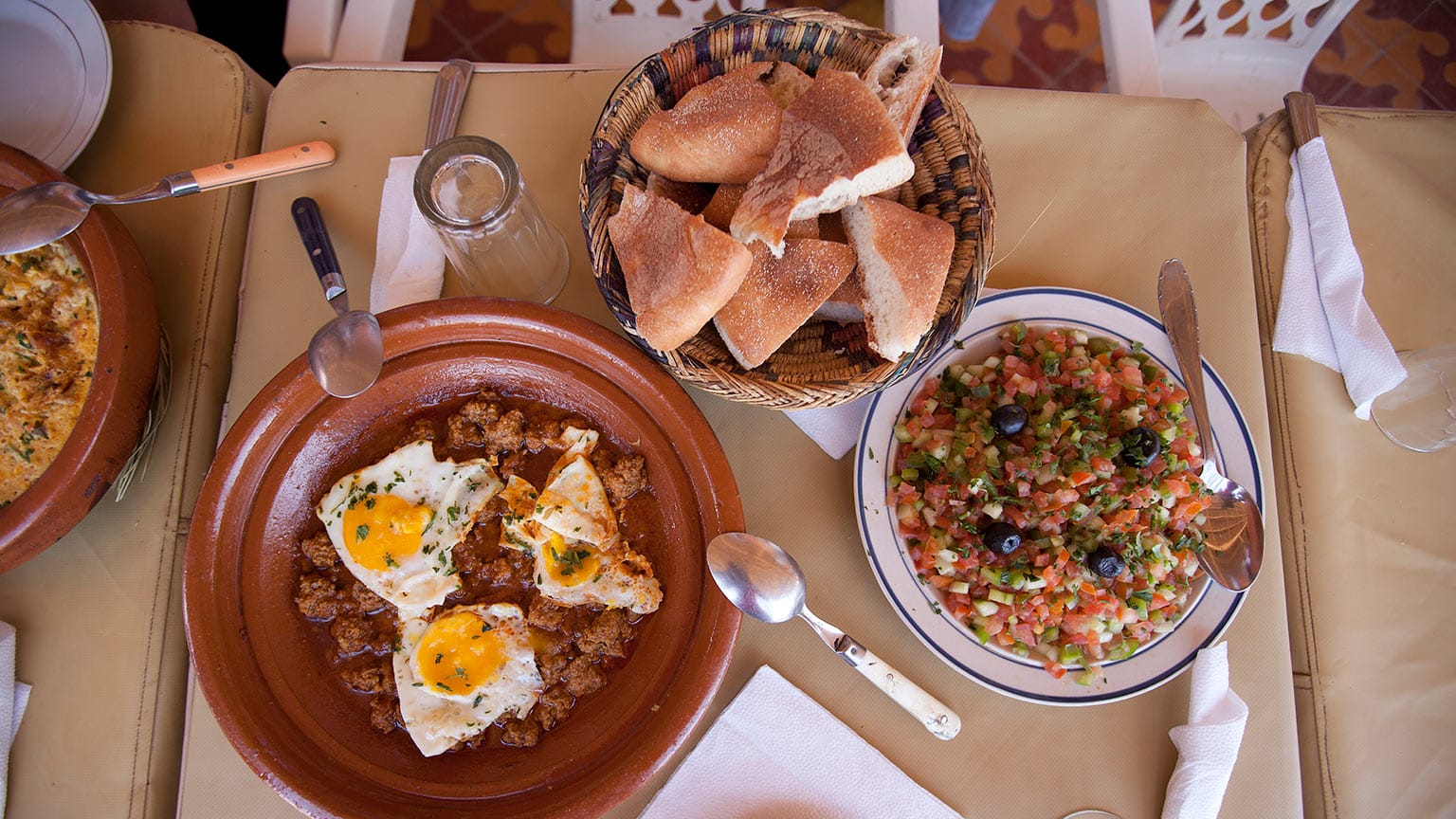
Our groups typically eat together to share dishes and enjoy the experience, though this is optional. In some areas, dining choices are limited. Budget around $10–15 USD per meal and carry sufficient local currency. For an overview of Moroccan cuisine including tagine, couscous, pastilla, harira, and fresh seafood, see this Lonely Planet guide to Moroccan food.
RESTROOMS
In Morocco, access to public restrooms often requires a small fee, usually 1 or 2 Dirhams. We recommend keeping some small change handy. You’ll have opportunities to visit banks or ATMs early in the trip and regularly thereafter to ensure you can break larger bills into smaller denominations. While public bathrooms are normally quite clean, they may not always have toilet paper, so it's best to carry some with you.
RAMADAN
Ramadan starts on the evening of Friday, February 28, and ends at sundown on Saturday, March 29. Ramadan is a month of fasting observed by Muslims throughout the world, during which time the followers of Islam should not eat or drink between sunrise and sunset. There may be some limitations to services and disruptions to schedules during Ramadan, but generally our tours still operate effectively during this period and food is available to non-Muslims throughout the day. From 7-9 p.m., most people are at home to break their fast and make the final two prayers of the day, some locations may be closed during those hours and reopen afterwards. Some places may also open later in the morning. It is very important to display increased cultural sensitivity during Ramadan. Please wear loose fitting clothes that cover knees and shoulders, and try to avoid eating, drinking or smoking in public out of respect for those who can't at that time.
GROUP LEADER
All GEEO programs are led by a G Adventures Chief Experience Officer (CEO), whose role is to take the hassle out of travel and help you get the most from your trip. They’ll share information about the places you visit, suggest activities and restaurants, and introduce you to our local friends. While not traditional guides, CEOs have broad knowledge of the region’s history, culture, and daily life. On some excursions, local guides are used for deeper insight.
PROGRAM DETAILS
Emergency Contacts
If you need urgent help during your trip, call the local G Adventures office first. If no one answers, leave a detailed message with your name and contact information so they can return your call as soon as possible.
EMERGENCY CONTACT NUMBERS:
G Adventures Operator – Morocco
Open 5 days a week, Monday to Friday 9:00 a.m. to 5:30 p.m. local time (GMT).
During Office hours: +212 (0)528 824898
After hours emergency number: +212 (0)661 861950
If you are unable to reach anyone at either of these numbers, please call the G Adventures Regional Operations Manager Emergency Cell Phone: +44 (1858) 378000
If you are unable for any reason to contact the local office, please call the numbers listed below, which will connect you directly with the 24-hour Sales team, who will happily assist you.
Toll-free, North America only: 1 888 800 4100
Calls from UK: 0344 272 0000
Calls from Germany: 0800 365 1000
Calls from Australia: 1 300 796 618
Calls from New Zealand: 0800 333 307
Outside North America, Australia, New Zealand, Germany and the UK: +1 416 260 0999
Packing List
See our blog post of staff-recommended gear to help you pack for your upcoming travels. You must be able to carry your own luggage—up stairs, on and off of transport, and during 15 to 20 minute walks. Bring one small or medium backpack or rolling bag (22-30lb) and one daypack for daily items. Space is limited on transportation, so oversized bags cannot travel.
As you prepare your packing list, we recommend checking average weather conditions for your destination.
SUGGESTEDOPTIONALDOCUMENTS
Fleece or warm mid-layer for cool mornings/evenings
Light windproof/waterproof jacket (it is unlikely to rain very much)
Sun hat
Personal clothing for cool to mild weather (long pants, long-sleeve shirts, a few warm items, and lighter items for midday warmth)
Daypack
Sturdy walking shoes
Sunblock
Sunglasses
Watch or alarm clock (or use your phone)
Flashlight or headlamp (or use your phone)
Toiletries – some hotels may not have shampoo and conditioner
Camera (or use your phone)
First-aid kit, including lip salve, aspirin, bandaids, anti-histamine, Dramamine, Imodium or similar tablets for mild cases of diarrhea, electrolyte powder, insect repellent, extra prescription drugs you may be taking
Light-weight silk sleep sheet
Travel pillow
Money belt
Water bottle
Phone/tablet for internet – most hotels have WiFi
Chargers for electronics, as well as converters/adapters, if needed
AirTags or Tile trackers
Packing cubes
Earplugs
Snacks – packing a few granola bars is a good idea; you can also buy snacks when you get there too, so don’t go crazy
Ziplock bags
Reading/writing material
Hand sanitizer/baby wipes
Passport (with photocopies)
Travel insurance (with photocopies)
Airline tickets (with photocopies)
USD/EUR cash
Credit or debit card (see personal spending money)
G Adventures vouchers, pre-departure information, and dossier
Any entry visas or vaccination certificates required
GEEO Classroom action plans for your group – this is sent 10-30 days before departure
*Laundry: Laundry facilities are offered at some of our hotels for a charge. You can also ask your group leader where the nearest laundromat is located. Many of the hikes take place during the hottest part of the day, so re-wearing clothes without laundering them may not be an option. Be sure to bring enough clothes to last a week without being able to do laundry.
Passports and Visas
Travelers are responsible for securing all required travel documents and meeting the entry requirements for every country on their itinerary, including applicable transit/layover countries.
PASSPORT
All travelers must have a passport valid for at least 6 months beyond your trip dates with enough blank pages for stamps. Need to apply or renew? Start here.
ENTRY/VISA REQUIREMENTS
Visa rules change frequently—always verify the latest requirements on the U.S. State Department Country Information Pages. Non-U.S. passport holders should verify requirements with your country's official government resources. Use the tool below to see entry requirements for your specific itinerary.
Entry information below is provided by Sherpa, a third-party service and trusted G Adventures partner. You must search each of your destination countries separately; “Add connection” solely searches transit visa requirements. Additional fees apply if you choose to purchase any services through Sherpa.
Money Exchange
The local currency in Morocco is the Moroccan Dirham (MAD). As exchange rates fluctuate, refer to www.xe.com for current rates.
We recommend relying on a mix of cash, cards, and local currency. Euros and U.S. dollars are the most commonly exchanged foreign currencies. Carry some USD/EUR in small, clean, recently issued bills for exchanging into MAD, or in case of credit/debit card issues. The amount you bring will depend on your personal spending habits, but many travelers find that bringing $300–500 USD (or the equivalent in Euros) to exchange is a reasonable estimate. Visa is the most widely accepted credit card, and debit cards with Cirrus or Plus logos are generally usable at ATMs.
While some restaurants, shops, and hotels accept cards, cash is more reliable, especially for small purchases, tips, and markets. Foreign transaction fees may apply, so check with your bank in advance. Plan to withdraw or exchange money early in the trip as it may be harder to access exchanges later in the itinerary.
Emergency Fund: Please also have access to at least an additional $200 USD (or equivalent) as an emergency fund. This would be used only in rare situations—such as natural disasters or major transportation disruptions—that require unplanned changes to the itinerary. While uncommon, it is a responsible precaution to have these funds available.
You can read more GEEO advice in our post, Smart Travel Finances: Your Guide to Money, ATMs, Fees, and Safety Abroad
Tipping
Morocco has a strong tipping culture. Tipping is an expected, though not compulsory, component of this program and an expression of satisfaction with the people who assist you on your trip. It is also one of the most direct ways you can have a positive economic impact within the local community. Although it may not be customary to you, it is of considerable significance to the people who will take care of you during your travels. Here are some guidelines for tipping:
Tipping Kitty: Your tour leader will likely collect a tipping kitty at the welcome meeting to cover group tips for local drivers, guides, and support staff. This helps streamline tipping throughout the trip and avoids repeated small collections. The amount is typically the equivalent of $30–40 USD per person, payable in MAD or USD. Your tour leader will confirm the exact amount and how it will be used.
General Tipping: For service providers such as waiters, tipping around 10% is customary, depending on the service.
Local Guides: You may tip your local guides individually, or your tour leader may offer to collect money and tip on behalf of the group. Recommended tipping ranges from $1–2 USD per person per day, depending on the quality and length of service.
Main Driver: Your main driver will be with the group throughout the program, covering long distances across Morocco. A tip of approximately $60–75 USD total per traveler is customary and greatly appreciated in recognition of their service.
Tour Leader: At the end of your program, if you felt your G Adventures tour leader did an outstanding job, tipping is appreciated and sometimes expected. The amount is entirely up to you, but as a guideline, $8–11 USD per person per day is typical (approximately $120–165 USD total).
Your tour leader can provide specific recommendations based on the circumstances and expectations during your trip.
Vaccinations
GEEO cannot provide any medical advice, so it is very important to consult your doctor or a travel clinic about which vaccinations you will need for your trip. We recommend contacting Passport Health, which has travel clinics located throughout the United States. You can also check the CDC's recommended vaccinations for your destination. Please take this seriously!
Flights
Wait for official trip confirmation via email from GEEO before booking your flights. Prices tend to be lowest 90–120 days out, but that window varies by route and year. Neither GEEO nor G Adventures bears responsibility for any flights purchased before the trip is confirmed.
*This program begins in Casablanca and ends in Marrakech.* Please double-check our itinerary for the date by which you must arrive in Casablanca, which usually means departing the U.S. one day prior. You may want to arrive in Morocco one or more days early in case you have flight disruptions. You can arrive at any time you choose, but try to make it in time for our 6:00 p.m. Welcome Meeting on Day 1.
You can depart from Marrakech at any time on the final day of the program. Most participants opt for a multi-city flight—arriving in Casablanca and departing from Marrakech. This approach is generally the most straightforward and usually adds less than $100 to your airfare compared to a round-trip ticket to Casablanca.
However, if you choose a round-trip flight from Casablanca, here are a few options for your return from Marrakech to Casablanca at the end of your trip:
Fly: There are affordable non-stop flights from Marrakech to Casablanca, but booking a flight separate from your transatlantic ticket could cause issues if you experience flight disruptions.
Train: Take a train from Marrakech to Casablanca and then another train or taxi from the train station to the airport. We recommend buying train tickets at least a day in advance—your Tour Leader can assist with this. From Casablanca’s train station, you can continue to the airport by train or taxi.
Private Transfer: We can pre-book a transfer for you from your hotel in Marrakech directly to the airport in Casablanca, but it is likely the most expensive option.
Plugs and Converters
Morocco uses Type C and Type E plugs and the voltage is 220-240V. To use your electronics safely, you’ll need to consider:
1. Adapter (plug shape)
Adapts your U.S. plug to fit another type of socket. See our recommended all-in-one travel adapter in our Gear Recommendations post.
2. Converter / transformer (voltage)
Steps the outlet voltage down to 120V for U.S. appliances that can’t handle higher voltage.
Check what you need: Look on your device's plug or power brick. “Input: 100-240V” works worldwide—you only need a plug adapter. Any range narrower (e.g., "110-120V" or “Input: 120V”) means you need an adapter and a voltage converter to avoid damage. Converters are inexpensive and available online or in travel stores.
Weather
Morocco's weather in March is much like the start of spring in the United States, depending on the region (Marrakech can be a bit warmer). In mountainous areas (like the Atlas range), temperatures are cooler, and some mountain peaks remain snow-capped throughout most of the year.
Historical Monthly Weather Averages
Casablanca
Loading...
Unable to load weather data.
Fes
Loading...
Unable to load weather data.
Merzouga
Loading...
Unable to load weather data.
Marrakech
Loading...
Unable to load weather data.
Average High
Average Low
Rainfall
Advice From Past Participants
Morocco is an incredible destination, but it comes with some surprises. Here are the key things past travelers wish they had known:
1. Bring $300–500 in small USD bills—Morocco is cash-based and tipping is extensive
2. Cooperatives offer guaranteed quality and directly support local women, but medinas have much lower prices
3. Expect serious walking on uneven surfaces and long, hot bus rides with weak A/C
4. Summer heat is extreme—bring electrolyte powder, portable fan, and sinus medication
5. Pack light luggage with wheels, round electrical converters, and more shorts than you think
6. Credit cards are unreliable even when accepted
7. Always ask before photographing people
8. Vegetarian options are widely available
Expand each section below to read more.
Expand for Money/Shopping Advice
Money & Tipping - You'll Need More Cash Than You Think
"I was not prepared for the amount of tipping that had to be done and did not bring enough cash for it which forced me to dip into my cash reserves for a different trip."
"I would have brought more USD to exchange for all of the tipping and water."
"As far as money goes, I needed way more small bills (especially change) than I had."
Don't Count on Credit Cards
"Do not rely on credit cards. Many places say they take cards, but when it comes to actually paying, they do not."
Ask About Shopping Opportunities
"I recommend asking your tour leader about the shopping opportunities throughout the trip. I found it hard to apportion out my spending money because I didn't know what might be coming up."
Shopping - Skip the Cooperatives, Hit the Medinas
"Don't wait to buy goods at the cooperatives. The cooperatives are VERY expensive, and you can find the same things much cheaper at local medinas."
"I ended up buying a lot of stuff at the cooperatives. While you know that you are getting good quality, you can find quality stuff for cheaper prices in places like Essaouira and Marrakech."
Bargaining is Essential
"In case you get to Casablanca early, know that you can and should bargain over EVERYTHING. In fact, you probably shouldn't buy anything until your guide has explained to you how this works. Prices can be 5x normal because you are American."
Expand for Health/Physical Activity Advice
Physical Activity - It's More Intense Than You Expect
"Even though the description talks about all of the travel, you really can't comprehend it until you do it."
"There is a considerable amount of climbing up and down on uneven surfaces on this trip. A hiking stick and the wisdom to know when it is too much, is advised."
Lots of Walking
"If anything, I would just add that there is a lot of walking. Most days it was not difficult, but there were long days. Also, if you are short like I am, some of the stairs are steep."
Transportation - Prepare for the Roads
"Be prepared for the driving if you are sensitive to it! Definitely take Dramamine if you get carsick easily, and be sure to take at least 30 minutes before any long drives."
"It was on the itinerary, but really being prepared for the long car rides between locations."
"No WiFi on the tour bus and weak A/C."
Summer Heat - Bring Cooling Strategies
"How HOT it would be. Glad I brought as much electrolyte tablets and Imodium and Pepto with me. My traveling friend brought a portable fan with her and that was helpful on those long bus rides."
"Be prepared for very hot temperatures. My fan (with a strap to wear it around my neck) stayed on most of the day and night."
Stock Up Early
"Ask to go to grocery store before you take off - buy waters, soda, etc... maybe ask guide if there would be room for a cooler to put peoples drinks in… know that drinks will not be cold."
Health & Wellness - Come Prepared
"Yes, chances are you will get sick either from the food or dehydration so see your doctor in advance for some medication."
"I wish I'd brought some sinus medication, as I really underprepared for how much the general dry conditions of Morocco and the blowing sand in the desert would aggravate my sinuses."
Electrolytes are Essential
"Taking electrolyte powder is a very good idea... it's hot and it's hard to drink enough water at all, sometimes electrolytes are really needed."
"Recommend people bring electrolytes, especially for the trips offered in July and August."
Expand for Packing/Dress Advice
Dress Codes are Flexible
"Don't worry about dressing conservatively. The people we encountered were not offended by tank tops. Be considerate but don't feel like you have to cover up all the time."
"I wish I would have known that as tourists we didn't have to dress as conservative as the locals. I would have brought more shorts/skorts, instead of pants."
Luggage & Essentials
"For luggage handling–even if it is on wheels, super large suitcases packed heavily can be difficult to carry up steps at hotels and takes up a lot of space in the back of the van."
"The electrical outlets are all recessed into the wall so not all converters fit. You have to have a round one or one that is smaller than one and one half inches wide."
Expand for Cultural Expectations Advice
Cultural Notes & Experiences
"A good number of people you will encounter do not want to be photographed. Make sure you ask first."
"Morocco has a LOT of stray cats. Feeding them encourages them to hang around."
Final Thoughts
"Morocco is a friendly and relatively safe feeling place and the food is outstanding--enjoy it!"
"I didn't have a hard time finding vegetarian foods! There is also a vegetarian restaurant in Marrakech."
Extra Services & Costs
EXTRA SERVICES TO PRE-BOOK
Send us an email if you would like to pre-book any of the extra services listed below for your program. Space and availability are limited, and pricing is not guaranteed until booked.
*Extra services are non-refundable within 30 days of your program's start date.
*Airport transfers require Day 1 arrival/final day departure or pre/post hotel nights booked through GEEO.
*Costs will be added to your final balance.
Private/Single Room
$239 (4 left)
Pre-trip Hotel (per night)
Hotel Campanile Casablanca - Single: $50, Twin/Double: $60
Post-trip Hotel (per night)
Moroccan House Marrakech - Single: $45, Twin/Double: $60
Get an early start and watch the sunrise over the red dust, palm groves, and majestic open landscapes of Marrakech from a hot air balloon. After soaking up the sights, refuel with an authentic Amazigh breakfast in a Moroccan tent.
*Please note if you purchase the Marrakech Hot Air Balloon ride on the final day of your tour you will not finish until 10am. We recommend booking your departing flight no earlier than 1pm to ensure you have enough time to make it to the airport.
Optional On-Site Activities
Optional activities can be booked and paid for locally. Prices shown are the most recent figures from participants and G Adventures. Use them as budgeting estimates only—actual costs may vary. If you arrive early or extend your stay, check out our curated list of Viator tours for additional activity ideas.
Hassan II Mosque (Sat to Thur):120 MAD
Completed in 1993, the Hassan II Mosque is one of the largest and most impressive mosques in the world and can accommodate up to 105,000 worshippers at a time. Its minaret is the tallest in the world, standing at 210 meters tall.
Villa de Arts (Tue to Sat):free
The Villa des Arts is a contemporary art museum that was inaugurated in 2014 and features a collection of modern and contemporary Moroccan art, as well as temporary exhibitions by international artists. The museum is housed in a beautiful historic building that was originally built in the 1930s as a cultural and social center.
Jewish Museum (Mon to Fri)::30 MAD
The Museum of Moroccan Judaism is dedicated to showcasing the rich history and culture of Moroccan Jews. It houses a collection of artifacts, documents, photographs, and videos that provide a glimpse into the life and traditions of the Jewish community in Morocco. The museum also hosts cultural events and educational programs throughout the year.
Ville Nouvelle Exploration:
Hit the newer part of Fès to see life in action. Find a sidewalk café to sip mint tea and watch everyday life go by.
Dinner in Converted Fès Riad (2-3 hrs):400-500 MAD
Sit down to a fantastic meal in a renovated riad, a Moroccan palace that has been transformed into a restaurant. Tantalize your taste buds and senses with delicious, local cuisine accompanied by music and belly dancing.
Madrasa Bou Inania:10 MAD
Madrasa Bou Inania is a beautifully preserved Islamic school and a prime example of Moroccan architecture, located in the heart of the medina. It was built in the 14th century and features intricate geometric tilework, ornate stucco decoration, and carved cedarwood elements. The madrasa is still in use today and visitors can explore the courtyard, prayer hall, and student cells.
Merzouga Land Cruiser Desert Excursion:700 MAD
View the golden dunes of the Sahara desert on a land cruiser excursion. You'll be driven around the sand dunes of Erg Chebbi in land cruiser cars, taking in the views of the seemingly endless sea of sand. Pass a kohl mine en route to the village of Khamlia. Witness the delightful sounds of the African music of Gnawa — played by members of the community — as you enjoy a cup of mint tea with the locals.
Tagine Cooking Demonstration:120 MAD
Learn all about the quintessential Moroccan dish — tagine. Learn about the tagine itself (a clay pot) and different ingredients and spices. Enjoy the fruits of your labour for dinner.
Musée de Marrakech:50 MAD
Wander around the salons of the ornate Mnebhi Palace displaying various collections of Moroccan art forms.
Traditional Moroccan Dinner with Folklore Entertainment:
Experience a traditional 3-course dinner in the heart of the medina of Marrakech - Djemma El Fana square - and enjoy a folklore performance.
Jardins Majorelle:200 MAD
Visit this enchanting garden in the heart of the city designed by French painter Jacques Majorelle (1886-1962). Follow the pathways through trees, exotic plants, streams, and pools while watching the numerous birds who call this peaceful paradise home. (Please note that the entrance fee to Musée Yves Saint Laurent is an additional 30 MAD.)
Djemaa el Fna Market Square Visit:
Wander past fresh orange juice stalls and water sellers in colourful costumes reminiscent of an era past. See storytellers, magicians, and peddlers of traditional medicines as the day progresses. When the sun sets, the square fills with dozens of food stalls, and is packed with locals, entertaining chefs, and waiters. Grab a spot on a bench with other diners and try the “tanjia” (slow cooked lamb), harira soup, grilled seafood, famous Moroccan couscous, tajine, snails, or even sheep’s head (for the truly adventurous). Wash it all down with some spiced tea.
El Badi Palace:70 MAD
Visit the ruins of what was once the most ornate palace of the 16th-century. Its sunken gardens and pools give a glimpse into its former glory.
Bahia Palace Visit:10 MAD
The name “Bahia,” translates to “brilliance,” and reflect the palace’s beauty and the ambition behind its creation. The palace showcases a blend of Islamic and Moroccan architectural styles, featuring intricate marquetry, stunning tile work, and ornate ceilings. Its design includes several riads (traditional Moroccan houses with interior gardens), a harem section, and a grand courtyard, which was used for entertaining distinguished guests.
Saadian Tombs Visit:10 MAD
Visit the historical necropolis of the Saadian Tombs, rediscovered in 1917. The remains of Saadian Dynasty royalty and officials can be found here. Check out the exquisite architecture of this very popular place.
Hot Air Balloon Marrakech:
Get an early start and watch the sunrise over the red dust, palm groves, and majestic open landscapes of Marrakech from a hot air balloon. After soaking up the sights, refuel with an authentic Amazigh breakfast in a Moroccan tent.
*Please note if you purchase the Marrakech Hot Air Balloon ride on the final day of your tour you will not finish until 10am. We recommend booking your departing flight no earlier than 1pm to ensure you have enough time to make it to the airport.
Estimated Trip Costs
Free-time activities aren’t included in the program fee. Use the prices below as ballpark figures to decide which options fit your budget.
GEEO Program Fee: See our price in the top right corner
Optional Activities: $50-300 USD
International Airfare from the United States: Roughly $950-2,000 USD
If you require assistance searching for international flights, we would be happy to help you.
Airport Transfers: $50-125
Insurance: $30-200 USD
Please note: It is mandatory for all of our travelers to have Emergency Medical insurance that covers both emergency evacuation and repatriation to the sum of $200,000 USD. We also strongly recommend purchasing cancellation insurance as an add-on.
Tipping: About $200—we recommend $60-75 for your tour leader, $30-40 for your driver, and $100-120 for other tips such as local guides and waiters.
Meals not listed in the itinerary: $390-510 USD
Laundry, Drinks, Mobile Data, etc.: Make sure you budget for these types of expenses
Souvenirs: Variable—at your personal discretion
Vaccines: Variable—please consult with your primary care provider
Non-Educator Donation: $100 USD (suggested donation)
This is only for non-educator guests traveling with an educator on a GEEO trip. Educators and retired educators should not make this donation.
Photos
Book Any G Adventures Trip Through GEEO
Book any G Adventures program through GEEO, or transfer your existing booking over to us and receive:
5% educator discount or deepest available savings
Expert support 7 days a week (9 AM–9 PM ET)
Nonprofit insurance from $30 (vs. $150-200 elsewhere)
Comprehensive pre-trip guidance
Educator resources and professional development opportunities
Non-educators welcome! Your booking supports our 501(c)(3) mission.
GEEO is a 501(c)(3) nonprofit, and our mission is to help teachers travel by offering private educator-focused group trips—but we also partner with G Adventures to offer trips worldwide for anyone, not just educators.